


The problem of evil and suffering is one of the hardest realities Christians must face. It impacts all of us, often multiple times throughout our lives and sometimes in devastating ways. Stories of children being abused or innocent people being murdered stir emotions so powerful that many conclude the evil in this world makes God’s existence impossible.
For Christians, we know that God ultimately overcomes evil, but that does not remove the need to answer honest questions about its presence in the world today. And these answers must be formed before tragedy strikes. If we wait until we are in darkness, we risk being tossed around by our pain wondering whether God exists at all.
Because the problem of evil takes many forms, it helps to begin with the one that strikes the human heart hardest: the suffering of a child. If any example seems to challenge the existence of God, it is this one.
If God Exists, Why Do Innocent Children Suffer?
Children are the most innocent among us, and their suffering strikes us at the deepest emotional level. It is understandable why tragedies involving children are often used to object to the existence of God altogether. While entire volumes have been written to address this objection, sometimes the best place to begin is with a simple question:
Why is a child’s suffering evil?
At first, the question seems almost offensive, because we all know intuitively that a child’s suffering is wrong. But very few people ever stop to consider why it is wrong. Yes, suffering harms the child. Yes, suffering causes physical and emotional pain. Yes, suffering is needless. But these answers only describe what suffering does—they don’t justify why suffering is wrong.
And here’s the critical point: If God does not exist, then we are nothing more than molecules in motion. We are simply products of a blind, unguided evolutionary process. Everything that happens is simply the result of physics playing itself out since the universe began.
In such a belief system, a child’s suffering is not justifiably wrong. A child’s suffering simply is. How depressing of a worldview…
You may feel that it is wrong; you may even be horrified by it, but feelings alone cannot ground moral truth. If they could, then the serial killer who enjoys murder would be as justified in calling his actions “good” as you are in calling them “evil.” Emotion cannot carry that weight.
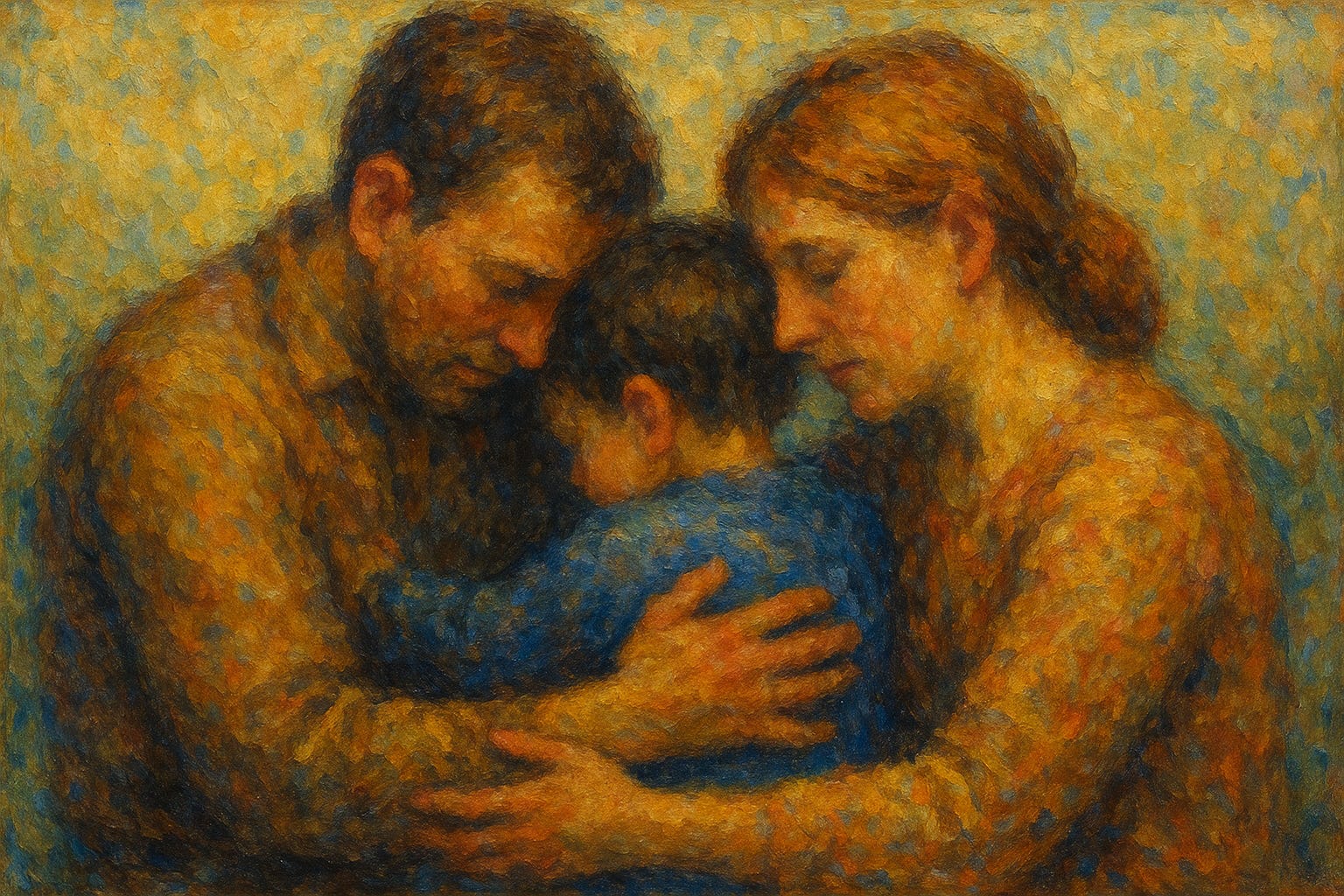
What is Evil?
To understand why something is actually evil, we must first understand what evil really is.
Evil is not an equal opposing force battling against God. Nor is it something God causes. Scripture consistently shows that evil is a corruption of God’s good creation, not a creation itself (e.g. Eccl. 7:29).
Think of a brand-new shirt. When you first buy it, it looks clean and feels great. But if you’re clumsy like me, you’ll spill ketchup on it within a week. The stain is a corruption of the shirt, but it cannot exist apart from the shirt. A stain without a shirt is nothing at all.
In the same way, evil is a distortion of good. It is a tearing, twisting, or staining of what God made right and beautiful. But it cannot exist on its own; it only exists by corrupting something that was first created good.
Why Evil Actually Points to God
C. S. Lewis said it best in Mere Christianity:
“A man does not call a line crooked unless he has some idea of a straight line.”
God’s moral law is our straight line. It is the recognizable standard of goodness written on every human heart. It is how we are able to justify why things can be truly wrong, and not just a matter of opinion enforced by the loudest or the strongest.
Just as a shadow is only visible because light reveals it, we recognize things as evil because we possess a real, knowable standard of what goodness should be.
The Proper Question
Evil cannot exist apart from a standard of goodness beyond ourselves. Natural processes cannot explain morality, for if morality is nothing more than a product of evolution, then nothing is universally right or wrong. It simply becomes whatever the strongest can enforce.
But nearly everyone recognizes that the suffering of a child, slavery, and genocide are truly wrong. Wrong for all people, at all times, in all places, no matter what the strongest say. That instinct only makes sense if there is a real moral law grounded in a real moral Lawgiver beyond ourselves.
So the proper question is not: “Can God exist in a world filled with evil?”
Without God, there is no justification to call something evil to begin with.
The proper question is: “If God is all-loving and all-powerful, then why does He allow evil?”
There is a clear answer to this question. An all-loving, all-powerful God can permit evil for a limited time in order to bring about a greater good. We’ll explore this challenge more next week.
For now, reflect on this:
Our outrage at evil is not random. It is a cry for justice. It is a recognition that the world is not as it should be. And it is an emotion that only makes sense if there is a recognizable standard of goodness beyond ourselves to compare it to. A standard that must come from somewhere.
Evil does not disprove God. It requires Him as the ultimate standard of goodness.
Absolutely! I believe God can work through evil to bring good.
Amazing explanations and imagery. I like the T-shirt analogy!