


Few biblical accounts lead to more heated discussion than creation. Some argue the earth is young, while others argue it’s old. Some argue death existed before the fall, while others say it started after. The creation debate is challenging because scripture doesn’t give us more than a surface-level account.
Many assume that modern scientific discovery is to blame for the rift, but the reality is that this mystery has been pondered since before the time of Jesus.1 That being said, science has certainly added to the debate in a significant way. New creation stances have since emerged, such as Evolutionary Creationism, a view that holds God used evolution as a creative mechanism.2
While debate remains in Christianity over how God created, the single most important thing to remember is that all sides agree on one thing:
That God created.
But whatever position one takes in the creation debate, there is one scientific framework compatible with each of them: the often misunderstood concept of Intelligent Design.

Intelligent Design Is a Positive Claim
Many wrongly assume Intelligent Design (ID) theory makes a negative argument. But ID does not argue, “Darwinian evolution has unsolved problems, therefore ID is true.” Rather, it argues that design is detectable and attempts to develop models for tracing it.3
It is also important to note that ID science only attempts to detect markers of design, not identify the designer. For example, if ID methods were applied to newly discovered hieroglyphics, the conclusion might be that they show strong evidence of intentional design. The method itself would not indicate the author, however.4
Now, scientists may certainly use ID findings to support a broader case for God, just as many Darwinists use evolution to argue that God is unnecessary. But those are philosophical conclusions drawn from the science, not conclusions of the scientific methods themselves.
This is why there are ID scientists who hold to Young Earth Creationism, Old Earth Creationism, and even Evolutionary Creationism.5 Each position has ID proponents who claim God’s hand in the creation process.

Intelligent Design Is a Forensic Science
Like other scientific fields, Intelligent Design uses observation, hypothesis, and experimentation. It attempts to draw conclusions from the results and engages in peer review for validation.6
It’s also important to recognize that, like much of evolutionary biology, Intelligent Design is a forensic (origin) science. This is in contrast to empirical (operation) science.7
Operation Science: Studies regularities in the present. Experiments are repeatable, and recreation is possible. A good example would be chemistry, where we can consistently mix different chemicals and observe the resulting reaction.
Origin Science: Studies singularities, or past events that can’t be recreated. It creates models based on what we observe in the present, then applies them to the past to infer the most likely explanation. Evolutionary history, Intelligent Design, and criminal forensics would fall under this category.
Of course, there is debate over the terminology above. But regardless of one’s view on the labeling, it’s clear that inferring what most likely happened in the past is vastly different from performing repeatable experiments to test what happens in the present.

How Does Intelligent Design Science Work?
At this point, you might be thinking, “Well, that sounds great, but how does it actually work as a science?”
Like other fields, ID theories are complex and likely beyond the scope of a surface-level article. But there are a few good examples, broken down by scientists themselves, that can help us understand how the field operates.
Douglas Axe, who holds a PhD in chemical engineering, gives a great illustration using alphabet soup.8 Imagine someone serves you a bowl of alphabet soup, and you notice the word “PASTA” surrounded by empty space.
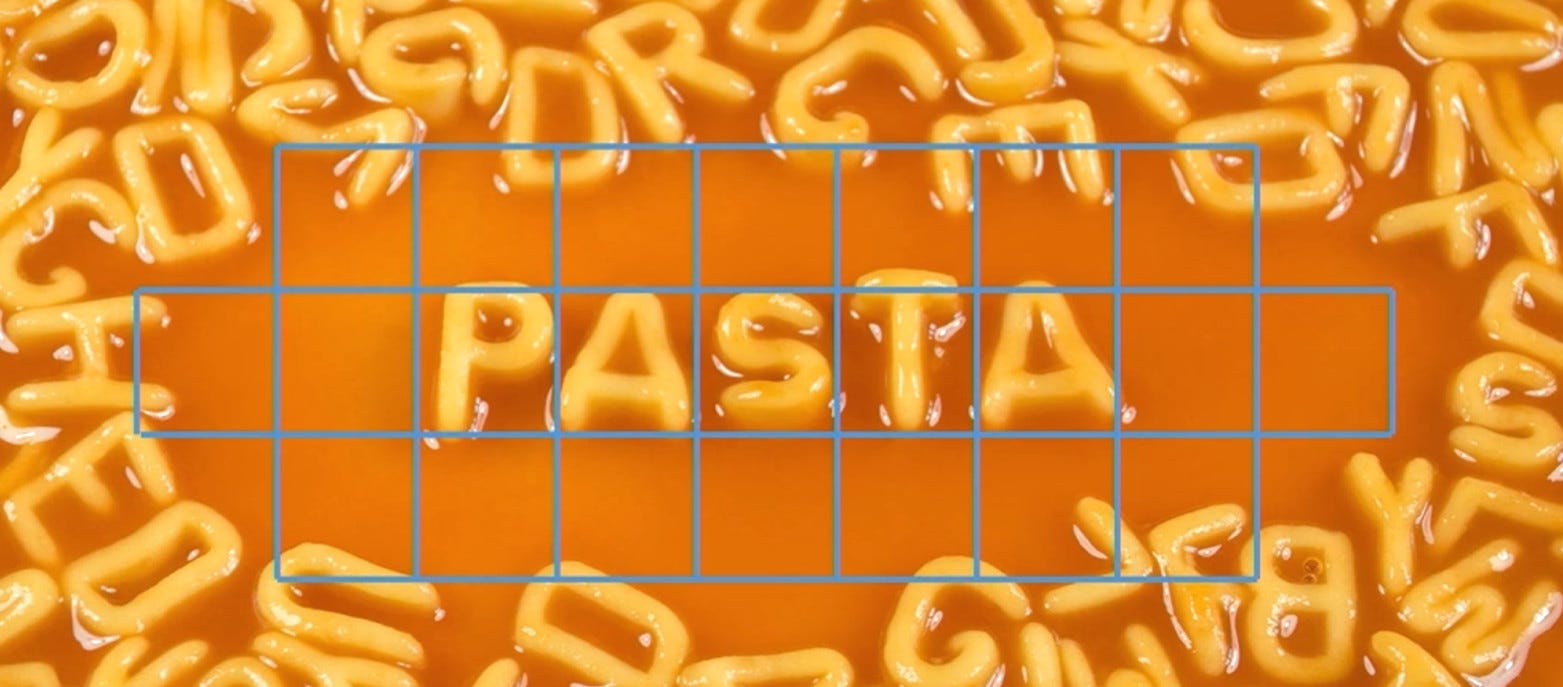
Our minds are able to instantly recognize that something intelligent most likely arranged the letters to create a meaningful message. But is it possible to detect this using science?
One way to approach this is through the mathematics of probability. We could draw grid squares roughly the size of the letters to identify the spaces where the pasta letters could land when poured. We could then estimate the probability of each square individually.
The 18 empty squares might each be considered 1 in 10 unusual, meaning we would have to look at a decent-sized region of soup to find an empty spot. It’s not super uncommon, but rarer than a space containing a pasta letter.
The 5 squares that spell PASTA might each be considered 1 in 100 unusual. This accounts for the 26 possible letters of the alphabet, as well as their orientation within the space.
With these extremely conservative rough numbers, the entire pattern would be considered 1 in (10¹⁸ × 100⁵) unusual. If we multiply that out, we get a result of 1 in 10 octillion.
In other words, under these assumptions, we would expect to pour roughly 10 octillion bowls of soup before encountering this particular pattern by chance. To put that number into perspective, if you poured one bowl every second, it would take approximately 23 billion times the estimated age of the universe to pour that many.9
The odds of such an intentional message being communicated by pure chance are astronomical. Yet for a mind, it poses no difficulty.
While this is a simplified demonstration, the point is that scientists are able to build models that attempt to detect intent. As an aside, it’s actually pretty neat that our minds are able to recognize patterns like this automatically, often with remarkable reliability.
But how do scientists know these models are reliable? One way is to test them against things we already know were designed and things we know occurred naturally. From there, they can make adjustments to improve their accuracy before applying them to things of unknown origin.10
Interestingly, when ID scientists apply this reasoning to fields like biochemistry, paleontology, genetics, and even the laws of physics, they find compelling evidence of design within each.11

Science Should Stand on Its Own Merits
Those who attack Intelligent Design science often combat a straw man version of it. Unfortunately, those who attempt to correct these misconceptions are often met with backlash. Many people simply don’t like the possibility that science could reveal evidence of an intelligent creator.
This is especially unfortunate considering that many of the pioneers of modern science viewed their work as a way to better understand God’s creation.
Consider Richard Sternberg, for example. He holds two PhDs, one in molecular evolution and another in theoretical biology.12 While working as a research associate at the Smithsonian, he faced professional backlash after simply allowing a scientific paper supporting ID to be published in a journal he edited. The situation became so bad that the U.S. Office of Special Counsel had to get involved.13
No one should get to dictate what constitutes legitimate science simply because they dislike the conclusions people might draw from it. Such inquiry should be judged by its methods and evidence, not by its philosophical implications.
Science is at its best when it is allowed to follow the evidence wherever it leads. And interestingly enough, in doing so, Intelligent Design research has revealed some amazing things about nature.
Intelligent fingerprints appear to be all over it…
I will cover some of these powerful findings in future articles. But for now, it’s important to note that such discoveries are precisely what we should expect to find if we live in a God-created universe.
This makes Intelligent Design a remarkable tool that all Christians, no matter their view on creation, would do well to better understand.
Philo of Alexandria, On the Creation (De Opificio Mundi), sections 13–15, translated by C. D. Yonge (1854).
BioLogos, “What Is Evolutionary Creation?” BioLogos, updated February 6, 2024. Read online
William A. Dembski, Casey Luskin, and Joseph M. Holden, eds., The Comprehensive Guide to Science and Faith (Harvest House Publishers, 2021), chap. 15.
Ibid.
J. B. Stump, ed., Four Views on Creation, Evolution, and Intelligent Design (Grand Rapids: Zondervan, 2017), 7–15.
Dembski, Luskin, and Holden, Comprehensive Guide, chap. 15.
Norman L. Geisler and Frank Turek, I Don’t Have Enough Faith to Be an Atheist (Crossway, 2004), table 6.2. Adapted from multiple sources.
Douglas Axe, “The Math That Disproves Materialism,” YouTube video.
Author’s calculation, assuming one bowl per second, 365.25 days per year, and a universe age of 13.8 billion years: 10²⁸ ÷ (31,557,600 × 13.8 × 10⁹) ≈ 23 billion universe lifetimes.
Dembski, Luskin, and Holden, Comprehensive Guide, chap. 15.
Ibid.