


The oneness of God and the doctrine of the Holy Trinity are among the most confusing aspects of Christianity. And if we’re being honest, many of us feel a sense of pressure, failure, and even shame when we struggle to grasp it.
As a believer who was once frustrated trying to comprehend the Trinity, I know that struggle well. I sought out pastors, books, and countless explanations attempting to make sense of it all, only to find myself unsatisfied and still confused.
Christianity holds that God is one, yet the Father is God, the Son is God, and the Holy Spirit is God. As a normal thinking person, I could not wrap my head around it. How can there be one God, while also speaking of what appears to be three?
After years of frustration due to my lack of understanding, I finally realized I was approaching the subject all wrong.
The Usual Explanation
If you’ve been a Christian for any decent amount of time, chances are you’ve come across the picture below. The classic triangle diagram is meant to show how God can be both three and one at the same time.
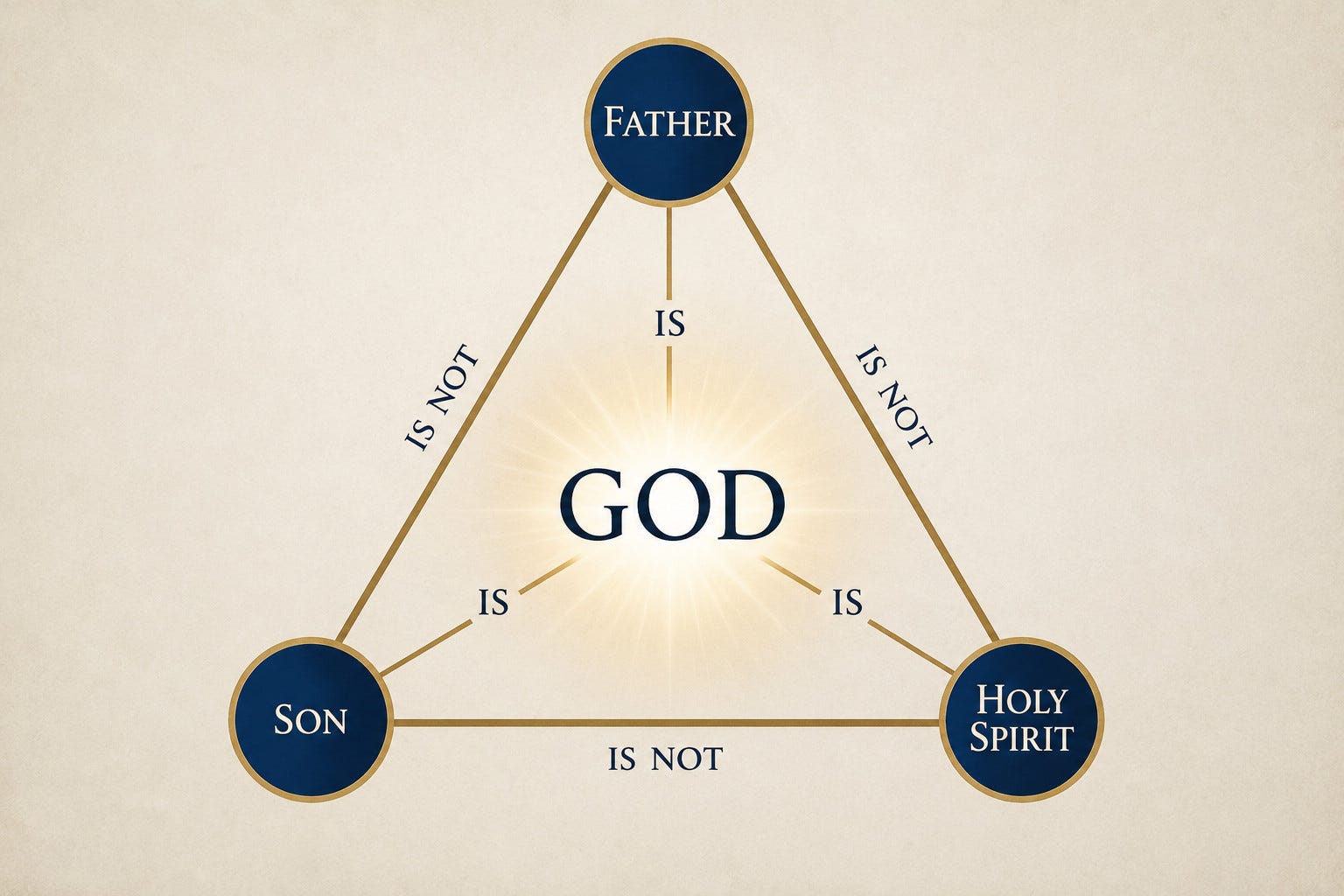
A triangle has three distinct points or sides. Each point can be seen as one of the Persons of God: the Father, Son, and Holy Spirit. This example is often used because, while each point is distinct, they are all equally part of the same triangle.
The diagram serves as a useful analogy, but if you’re anything like me, you may have never found the explanation completely satisfying. Sure, it kind of explains how three distinct things can still be one, but does the triangle diagram mean each Person is only a part of God?
That’s called Partialism, which is considered a heresy.
Ok… maybe God is one being who simply reveals Himself in different modes at different times?
Well, that’s Modalism, which is also a heresy.
No matter where I turned, every attempt to make sense of the Trinity seemed to create a new problem. I couldn’t quite grasp it…

One Nature
It wasn’t until I understood the difference between personhood and nature that I began to better apprehend the Trinity.
As humans, we have distinct personhood. I am me and you are you. Yet one thing we both share is our human nature. We may be distinct people, but we are both fully human.
Likewise, when we refer to God, we often imagine a person. In a sense, that is appropriate because the Father, for example, is a Person who is God. But when the oneness of God is invoked, it is not His personhood being referenced, but His divine nature.
And unlike humans who are finite and possess differing qualities within our human nature (strength, intellect, hair color, etc.), God is infinite. He is altogether uncaused, eternal, perfect, all-knowing, all-good, all-loving, all-powerful, and present everywhere.
This means that we, as humans, have the potential to change. We can grow smarter or stronger, for example. But God, who is already limitless and perfect in every way, cannot change. Change implies a finite, limited movement from one state to another; from lacking to possessing, from lesser to greater.
But if God is infinite and lacks nothing, how could He change? There cannot be multiple degrees of perfection, goodness, or infinitude. When we consider this, we realize:
Whatever the Son knows, the Father knows, for there cannot be differing degrees of divine all-knowingness (omniscience).
Wherever the Holy Spirit is, the Father is, for there cannot be differing degrees of being everywhere at once (omnipresence).
Whatever good the Father wills, the Son and the Holy Spirit also will, for there cannot be differing degrees of divine all-goodness (omnibenevolence).
To suggest otherwise would mean there are differing levels of perfection and infinity. But that is impossible.
The closest analogy I have found to demonstrate this point is the simple math equation:
1 × 1 × 1 = 1
Each number “1” on the left side of the equation is fully distinct. Yet the result still equals 1. The 1’s are distinct objects, but identical in their essence and value.
Like every analogy for the Trinity, this one eventually breaks down. But for the first time, I stopped trying to force God into categories designed for finite material things.
Note: The above references to the Son refer only to His infinite divine nature, not to the finite human nature He took on when He became man.

An Incomprehensible God
Arnobius once prayed:
“We are not surprised if You are beyond knowing. We are more astonished if You were clearly comprehended.”1
I think this is the most important part many people leave out when trying to explain the Trinity. So often, we spend time creating analogies meant to explain God in ways our minds can grasp. While they can certainly be useful in helping us apprehend what Scripture means when it calls God one, it is crucial to communicate something else:
We may be able to apprehend God, but we should not expect to fully comprehend Him.
If God is truly an infinite being, why do we as finite creatures expect to completely grasp Him?
C. S. Lewis makes a similar point in Mere Christianity when he writes:
“That is one of the reasons I believe Christianity. It is a religion you could not have guessed. If it offered us just the kind of universe we had always expected, I should feel we were making it up.”2
I once heard Frank Turek state it perfectly:
“It would be strange if God were not somewhat strange to us.”
This had been my main holdup all along. I was trying to fully comprehend an incomprehensible being.
The Mystery of the Holy Trinity
As Norman Geisler perfectly states:
“God is one in Essence, but three in Persons. God has one nature, but three centers of consciousness. That is, there is only one WHAT in God, but there are three WHOS. There is one It, but three I’s.
This is certainly a mystery, but not a logical contradiction.”3
The Trinity is an amazing thing when you really reflect on it. For example, the relationship between a parent and child isn’t just some arbitrary thing God made up. It is a direct reflection of God Himself, mirroring the eternal relationship between the Eternal Father and the Eternal Son.
God also didn’t need to create us, because He obviously wasn’t lonely. Therefore, He has no reliance on us to love or serve Him. He simply chose to create us out of His amazing love and glory.
So many questions become clearer by simply reflecting on the Holy Trinity.
But we should never expect, as limited creatures, to fully understand the glory of God. If we could, then we should rightly ask whether we are simply making Him up. Instead, in my opinion, it is best to preface any discussion of the Holy Trinity with the word “mystery,” so that people understand right away that they should not expect to fully grasp it.
While we should certainly attempt to apprehend how the Father, Son, and Holy Spirit are one, if we convince ourselves that we must fully comprehend it, we will always be left frustrated. The reality is that our limited minds will never be capable of exhaustively understanding an infinite God.
Had I learned this early on, I would have saved myself a lot of frustration. So if you remain partially confused by the mystery of the Holy Trinity, that’s okay; welcome to the club.
There’s always room for one more.
Robert Elmer, The Fount of Heaven: Prayers of the Early Church, p. 20.
C.S. Lewis, Mere Christianity, chap. 2.
Norman Geisler, Big Book of Bible Difficulties, p. 367.
You offer such a practical way of understanding the Trinity in this article Justin. My favorite section has to be the "Incomprehensible" section. It's super helpful for folks wrecking their brains trying to fit the Trinity into a box, or at least imply that they have it "all figured out"!
I have a children's workbook series, and in the Life Science workbook, I have a section that "explains" the Trinity to young children. I use the illustration that God is made up of 3 persons, and operates by 3 functions. For kids, it seems to work to at least get them on the right path.
But as adults, we struggle with this concept as well; and this article certainly breaks things down in such a way that gets us as close as we possibly can to "comprehension":)
Another solid article. One avenue I might push you on a bit is how you handle the Old Testament and what to make of it. I think we have to account for the distinctness of the Father, Son, and Holy Spirit already present there, even if it is revealed more fully in the New Testament. There is also plurality language, like “The LORD says to my Lord” in Psalm 110, and Daniel 7 is an especially interesting example with the Son of Man receiving dominion, glory, and a kingdom. I think we sometimes forget that the Son exists pre-incarnation, and that the incarnation reveals what had been held in mystery.