


I love to debate truth and help others see that faith in Christ is reasonable. But along with that God-given passion comes a major weakness: I quickly become consumed by objections, often struggling to let unproductive conversations go.
Many of us have been there. Maybe it’s an argument, and three hours later you’re replaying it in your head, finally coming up with the perfect rebuttal on the drive home. Or maybe you’re twenty comments deep in a back-and-forth with a stranger online. You know it isn’t a productive use of your time or energy, yet your desire to defend truth keeps pulling you in. Instead of walking away, you let it consume you, distracting you from weightier matters.
This is honestly a major flaw of mine, and it’s why I have deleted most social media apps. I struggle to resist returning every arrow that’s fired my way. Instead of stepping back to assess the battlefield, I fixate on each individual shot, reacting rather than advancing.
Asking For Help
I recognized long ago that I cannot overcome this flaw on my own. For some time now, I have been asking God to help me shed this weakness, so that I may be more effective in my service to Him.
Thankfully, an “aha” victory moment came when I engaged with an article written by Darwin to Jesus (DTJ). DTJ is a Christian apologist who had just published a strong rebuttal to an atheist on the subject of morality.
After publicly commenting to let him know I found his argument well-articulated, I somehow got pulled into a back-and-forth with the very people DTJ had been addressing. The exchange eventually became unfruitful, and though I wisely stepped away, my mind continued to ruminate for hours afterward, right on cue.
So, I reached out to DTJ to ask how he deals with it, especially given his growing audience and the constant arrows aimed in his direction. I wanted to know how he remains engaged without appearing like he’s avoiding criticism. How does he successfully refuse to be pulled into endless exchanges?
To my surprise, he responded quickly.
When you have a family like I do and you are making content, you cannot be sucked down into the weeds with people all the time. You have to know when to cut the bait... If I engaged with everyone simply because they disagreed with me, I would have no time for anything else.
He was exactly right, and I appreciated being reminded of this bluntly. Then he offered a simple piece of advice that revealed something important.
It is okay to let them have the last word.
After chewing on this, I soon realized that when I don’t have the last word, my mind continues engaging an imaginary opponent. But when the last word is mine, and there are no objections left to answer, I find peace. That was the insight I needed.
My battles for truth are quietly morphing into battles to calm my mind. Continued disagreement is no longer about defending what is right, but a search to quiet my own discomfort with what feels unresolved and beyond my control.
DTJ pointed me in the right direction, but I still had work to do. I needed to understand how to break this cycle, which I could now see a bit more clearly.
After some time in prayer, I was led to explore the writings of Augustine, who also seemed to wrestle with mental rumination.
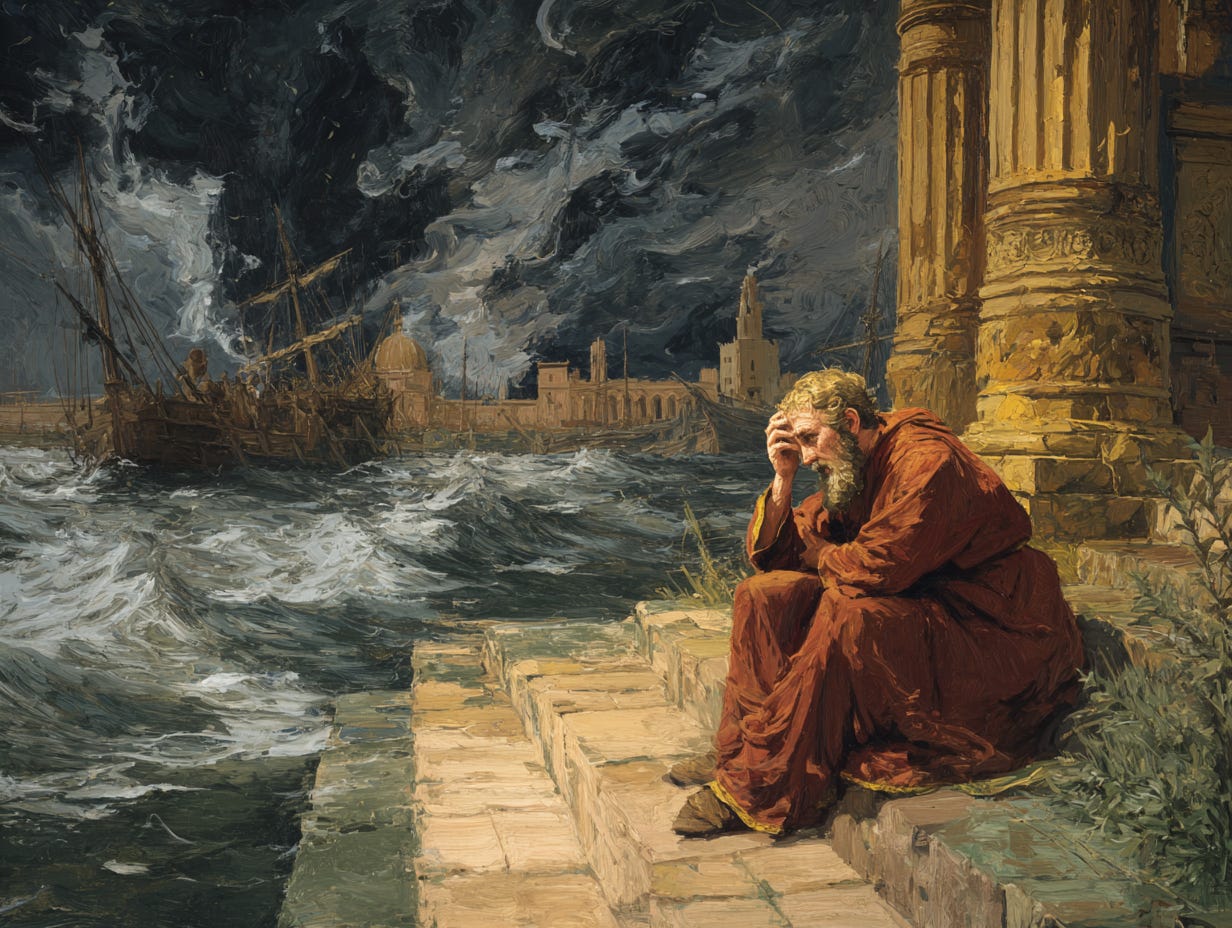
Augustine’s Restless Mind
St. Augustine of Hippo, who was foundational in the early church, wrote his work Confessions around 400 AD. When he wrote it, he was not a young convert still sorting things out, but a brilliant and mature Christian leader reflecting honestly on his inner life. His tenth book is a beautifully woven confession about restless memory.
During his confession, Augustine makes several profound conclusions that directly address the tension I have been feeling.
Why seek those to hear from me what I am: who will not hear from You what they themselves are?
They love truth when she enlightens, they hate her when she reproves.
These words capture the fallen human condition with remarkable precision. I am certainly guilty of hating hard truths in the moment. Often, I simply need time to reflect and allow the seed to germinate before I am willing to concede that I was wrong.
But still, even knowing that the seeds I plant may take time, I couldn’t understand why those unresolved moments left me with an immediate sense of moral discomfort. I did my duty after all, defending truth to the best of my ability.
In the words of Augustine:
Woe is me! Lord, have pity on me. My evil sorrows strive with my good joy, and on which side is victory, I know not.
I was comforted reading his struggle, and seeing myself in it. But I still needed answers. Thankfully I was tipped off to see what Thomas Aquinas had to say on the subject next.
Thomistic Wisdom
Thomas Aquinas is arguably one of the most brilliant theologians and Christian apologists to have ever lived. I was thrilled to discover that he wrote extensively on the subject of correcting and engaging with others. Was I finally on to something?
What I uncovered was a brilliant distinction between matters of justice and matters of charity. I learned we often feel that every injustice or bad take demands a personal response, as if doing nothing would be morally wrong. But in some cases, that is simply not true.
Consider the following example.
As a parent, if my child is caught doing something wrong, justice demands that the behavior be addressed, and that responsibility falls squarely on me. Correction is not optional because I have both authority and obligation.
But if I see a video of another child doing something wrong in another state, justice still recognizes that a wrong has occurred. What changes is my role. I am not the parent. I do not have authority, and I am not responsible for that child’s formation. In that case, correction is no longer a demand of justice placed on me. Any response I offer would be an act of charity, not obligation.
And charity must always be exercised wisely. As Aquinas observes, there are times when refraining from correction is the wiser course, especially when acting would cause more harm than good.
Using our parenting example above, imagine if I spent my mortgage payment on a plane ticket to travel across the country and correct the child in the video. Setting aside the likelihood of the police being called on me, I would also be neglecting the family I have a primary responsibility to care for.
Scripture is clear that our love must be ordered. In fact, Scripture teaches that failing to provide for one’s own household places a person in a position worse than an unbeliever.
In reading this, I came to understand why we often feel so passionate about defending truth. We have a God-given moral obligation to bear witness to it. But that obligation is not universal. It does not mean we must engage every person in every forum imaginable at the detriment of our primary responsibilities. That obligation must be governed by careful judgment.
And sometimes that means recognizing that someone is morally wrong, while being at peace with silently stepping away to higher priorities.
“What have I to do with judging outsiders?” - 1 Cor 5:12
There it was, the key I had been missing for so long. I had felt unsettled by what remained unresolved in the battle for truth, because I was treating charitable corrections as matters of obligatory justice. It carried the crushing weight of a false moral demand I could never hope to fulfill.
Once I understood this, my outlook changed. Charity, by its very nature, must be given freely and wisely. We are called to give joyfully, with purpose and thanksgiving. We are not called to give destructively or recklessly.
Rules of Engagement
To be clear, I am not advocating that we stand down in the fight for truth. On the contrary, I believe it is the most important thing worth fighting for. But learning discernment allows us to fight more effectively.
It ensures we don’t miss the forest for the trees.
I will be honest, I still have work to do. I will likely always struggle with mental replay to some degree, relying on God to overcome my shortcomings (as He often intends). Like Augustine, I am helpless without Him. But learning from those far wiser than myself has made one thing clear: if I am to grow and become more effective as a warrior for truth, I must learn to discern when action is required as a matter of justice and when it belongs to charity, given freely when it serves a wise purpose.
When that distinction is clear, the weight lifts. I am free to act decisively when justice demands, and equally free to remain silent when charity would be wasted.
Do not give dogs what is sacred; do not throw your pearls to pigs. If you do, they may trample them under their feet, and turn and tear you to pieces. - Matthew 7:6
The flow of information in our age is so aggressive that we feel like we always HAVE to be engaged. We don't. But it is a learning curve to live in such informed, fast-paced, integrated world and not lose our minds over interactions.
If every objection was worth answering than proverbs wouldn’t exist. “Do not answer a fool according to his folly lest you be like him, answer a fool according to his folly lest he be wise in his own eyes.” While there are lots of valid ways to interpret that verse, one I think people miss is the “Damned if you do and damned if you don’t.” Aspect of it as well.