


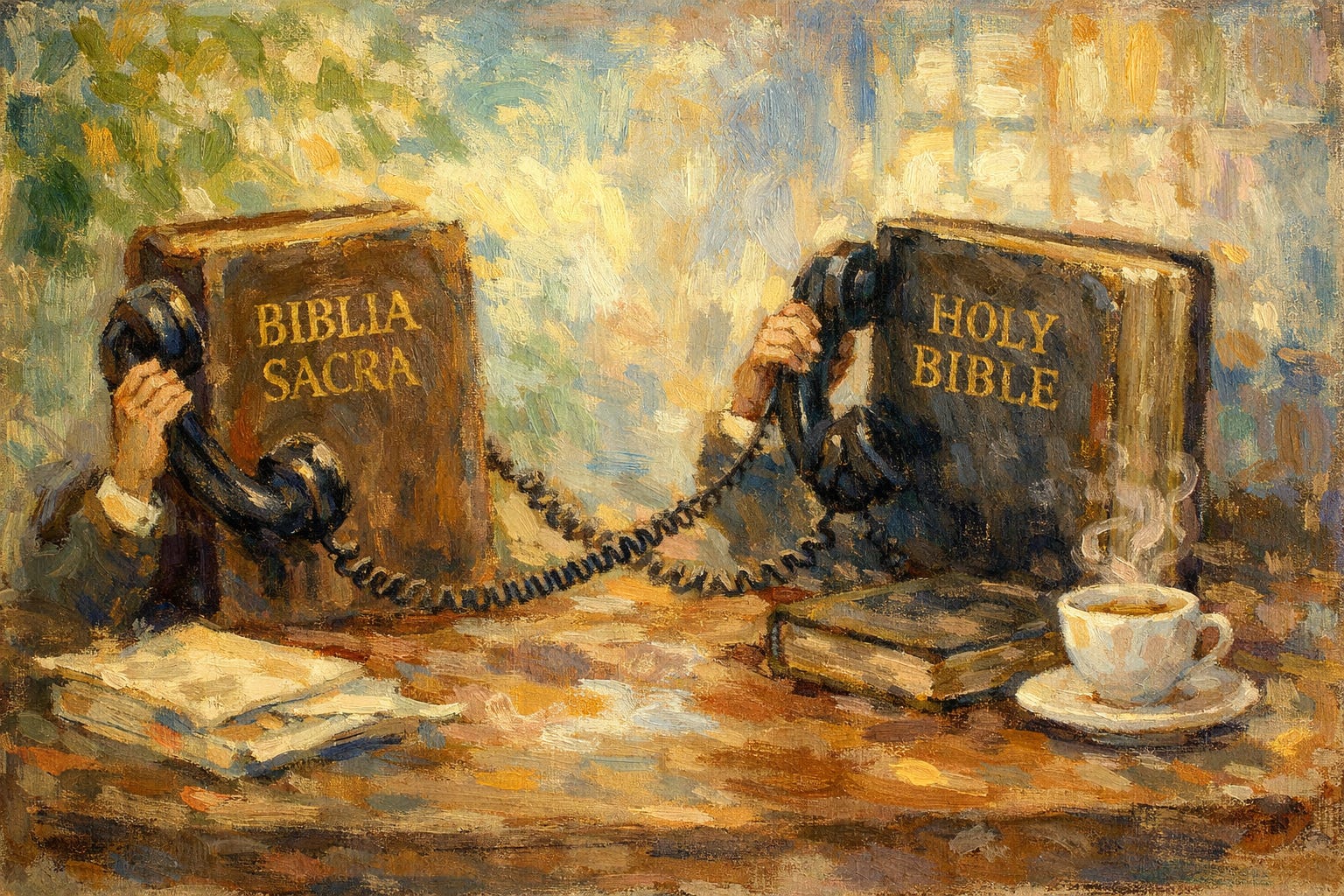
Many of us remember the good ol’ days of playing the telephone game in grade school. If you never had the privilege, the game is meant to show how a message changes when it’s passed from person to person. One student is given a sentence, whispers it to the next, and the secret continues around the room until “Grandma baked cookies” somehow morphs into “Grandpa made oopsies.”
It’s a memorable illustration. But because it resonates so well, skeptics love to use it as a quick objection to the Bible, often stating things like:
The Bible has been translated and re-translated through multiple languages over thousands of years, so the original message is inevitably lost.
Many devout Christians even share this concern. I have seen plenty of people cling to older Bible translations, such as the standard King James Version (KJV), which was released in 1769.1 They often do so in the hope that it is better preserved, even though the archaic wording can be challenging for most modern readers.
No offense to my KJV lovers out there.
The desire is certainly noble, as every believer should want a Bible that reflects what the original authors actually wrote. However, the telephone sentiment comes from a misunderstanding of how reliable modern translations are made and the incredible manuscript evidence behind them.
Modern Bible Translation
Contrary to popular belief, our Bibles are nothing like a game of telephone. While it’s true that newer translations often consult older ones, any translation worth its weight works directly off the original written languages and the oldest manuscripts available.
Take the New Testament, for example. It is the most well-attested collection of ancient documents in existence, with over 5,700 Greek manuscripts alone that scholars can reference when producing a translation.2 To put that into perspective, much of what we know about Julius Caesar comes from The Gallic Wars, which is preserved in roughly 250 manuscripts.3
No other ancient document even approaches the Bible’s level of textual preservation and reliability.
When translators create a modern Bible, they are not relying solely on the accuracy of previous English or near language versions. They are examining the ancient manuscripts written in the original languages themselves.
Why Are There So Many Versions?
Even knowing that our Bibles are made using ancient manuscripts, many Christians still naturally wonder why we have so many English versions available. The simple fact that we have so many options certainly fuels the telephone accusation.
This confusion arises, because most of us are not taught translation philosophy.
Translating the Bible can be challenging, because ancient words and ideas don’t always convert well into modern language. Thus, different translations aim to accomplish different goals.4
Formal Equivalence Translation
This method focuses on word-for-word accuracy from the original languages. The tradeoff is wording that may be slightly less smooth, but more closely reflects the structure of the text.
Examples: NASB, ESV, LSB, NKJVFunctional Equivalence Translation
This method focuses on conveying thought-for-thought what the original authors meant. The tradeoff is less adherence to the original linguistic structure, but smoother and more natural flow for today’s reader.
Examples: NLT, GNTBalanced Approaches
These translations aim to strike a healthy balance between formal and functional translation methods.
Examples: NIV, CSB
Each Bible translation accomplishes something unique, which is why it is generally wise to consult multiple translations when working through challenging passages. If you’re ever unsure about a particular version, here’s a neat open secret most people don’t know: if you flip to the first few pages of a printed Bible, you’ll usually find a preface explaining the translation philosophy used. This is the why and how behind that translation.
And if the printed preface doesn’t give the full picture, nearly every major translation has a website that goes even deeper, detailing the specific manuscripts used, the translation committee involved, and the guiding philosophy behind their work.
Which Version Should I Read?
Choosing a Bible translation can feel overwhelming, especially since people tend to be very opinionated on the topic. A helpful rule of thumb is not to limit yourself to just one translation. Different translations emphasize different aspects of the text, and comparing them can often bring clarity. That said, there is nothing wrong with having a preferred version for daily reading.
If you’re unsure where to start, your pastor is one of the best people to ask. They know you, your stage of spiritual growth, and how Scripture is taught in your church.
If you don’t yet have a church, I strongly encourage finding one. In the meantime, the free YouVersion Bible app is a great tool for exploring and comparing reliable translations in one place.
A Word of Caution
Be on guard against unorthodox versions, such as the Watchtower Organization’s New World Translation (NWT). This version, used by Jehovah’s Witnesses, was not produced using standard scholarly methods and intentionally alters key passages to diminish the deity of Jesus.5 Such translations are often easy to identify. Their advocates typically claim that all other Bible translations are corrupted, rejecting the broader field of biblical scholarship which encourages comparing multiple versions.
Your Bible is Trustworthy
Whichever version you prefer, the important thing is this:
You can trust that modern Bible translations faithfully reflect what the original authors wrote. The Bible you hold today is not the product of a confused game of telephone, but a carefully preserved document. One that God has guarded for millennia so His Word could reach you and millions of others.
What versions do you prefer to read?
“Scripture cannot be broken.” - John 10:35
Bible.com, King James Version (KJV), accessed January 27, 2026, https://www.bible.com/versions/1-kjv-king-james-version
Norman L. Geisler, Systematic Theology, Vol. 1: Introduction and Bible (Minneapolis, MN: Bethany House, 2002), 462.
Joseph M. Holden, Comprehensive Apologetics (Lynchburg, VA: Liberty University Press, 2013), 194.
Fee and Stuart, How to Read the Bible for All Its Worth, 4th ed., chap. 2.
Ron Rhodes, Reasoning from the Scriptures with Jehovah’s Witnesses (Eugene, OR: Harvest House Publishers, 1993), 10–11, 96–98.
A great perspective on Bible translations. I prefer ESV for personal study, but I highly recommend CSB for those with kids (a faithful and easy read for them).
Justin, Thank You! In all you do, keep on pointing followers and non-believers to the Word, brother! Your perspectives will give followers of Christ the conversational tools and context to help people young and old, not only hear the Word, but to ultimately live the Word.