


When contending for the truth of Christ, a commonly raised concern is that we cannot trust the Bible, particularly the New Testament, because the people who wrote it were biased. The apostles who documented the life, death, and resurrection of Jesus are not viewed as neutral sources, and therefore their writings are often dismissed automatically or treated with suspicion.
In short, the argument usually goes something like this:
Biased sources cannot be trusted.
The apostles were biased because they knew and followed Jesus.
Therefore, the Bible cannot be trusted.
Because of this, skeptics often ask for non-biased sources to prove Christianity is true. At first glance, the argument may seem reasonable. However, once we think carefully about the nature of bias itself and the historical context of Scripture, the objection quickly begins to fall apart.

Bias Does Not Automatically Eliminate Credibility
It is important to recognize that a so-called biased witness can still be highly credible. In fact, a biased witness can often be more credible than a detached or uninvolved observer.
Bias, which can be broadly defined as a personal inclination toward a particular conclusion, is often formed through personal experience.1 Although bias can at times become unreasonable or distort judgment, it does not always arise from ignorance.
For example, it is completely fair to conclude that Holocaust survivors were deeply biased against their Nazi persecutors. Yet no reasonable person would argue that this automatically disqualifies their testimony. In fact, those survivors were among the most important eyewitnesses to testify about the atrocities committed by the Nazis precisely because they experienced them firsthand.
In the same way, it is entirely reasonable to conclude that the people who witnessed Jesus rise from the dead would become strongly convinced of His teachings and identity. Their conviction does not make them unreliable. Rather, it is the exact kind of response we should expect from those who witnessed something so miraculous.
Those who experience powerful or life-changing events often become biased because they are the closest witnesses to those events, not in spite of them.

The Bible Does Not Stand Alone
While the Bible stands as the only infallible and divinely inspired source regarding Christ, it is certainly not the only historical evidence available.
The events surrounding Jesus are also referenced and discussed in numerous extra-Biblical sources (outside the Bible). Early Christian writers such as Clement of Rome, Ignatius of Antioch, and Justin Martyr provide very early writings that strongly corroborate the New Testament account.2
Beyond this, we also see references to Jesus and early Christianity from non-Christians such as the Roman historian Tacitus and the Jewish historian Josephus.3 While these men did not personally witness the risen Jesus nor arrive at the same theological conclusions as the early Christians, they still confirm important historical details surrounding Jesus, His crucifixion, and the rapid rise of Christianity.
One could certainly consider these non-Christian sources less biased, since they were not followers of Jesus. However, it is also important to recognize that they were not direct eyewitnesses themselves. They are secondary historical sources who did not personally experience the events surrounding Jesus.
Regardless, their accounts still strengthen the historical case for Christ by giving us a broader picture of how eyewitness testimony spread.

Test For Truth Not Bias
It’s clear that bias does not automatically negate truthfulness. Accordingly, we should apply the same historical tests for truth to the Bible that we would apply to any other historical work. Here are just a few examples.4
Does archaeology confirm details from Scripture? — Yes.
As Holden and Enterline put it, “no archaeological discovery has ever contradicted the Biblical record.”5 Furthermore, there have been over 190 excavation sites that actually corroborate Biblical accounts.
The Mamertine Prison, traditionally believed to have housed Peter and Paul in Rome, the Pool of Siloam, the Pool of Bethesda, and the Azekah Inscription affirming both Hezekiah’s existence and the Assyrian wars in Judah are just a few examples.6
Are other people mentioned in Scripture confirmed by other historical sources? — Yes.
Over 100 people mentioned in Scripture, including more than 30 from the New Testament, have been historically confirmed.7 These include Nebuchadnezzar, Caiaphas, King Herod, Herodias, John the Baptist, and many others.
Do the writings contain counterproductive details that signal truthfulness over agenda? — Yes.
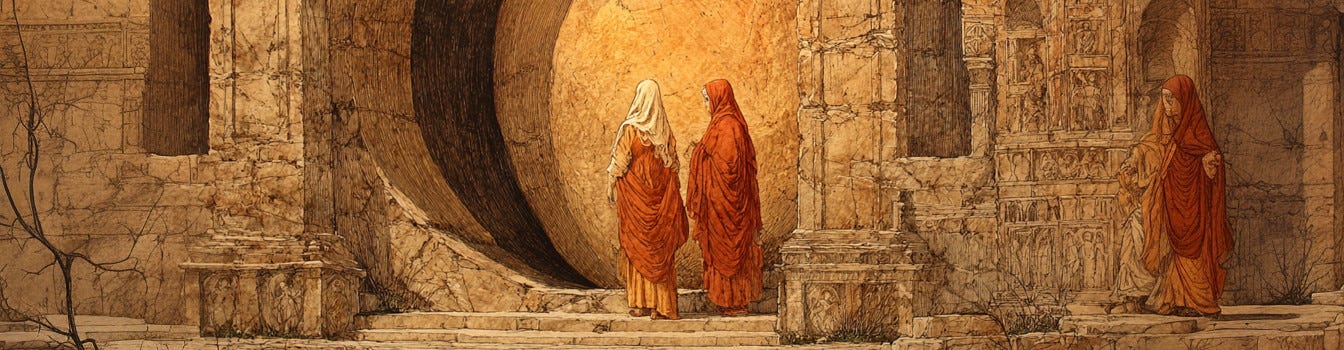
In the first-century Jewish world, women were viewed as unreliable witnesses. The Jewish historian Josephus even wrote, “From women let no evidence be accepted, because of the levity and temerity of their sex.”8 Yet the Gospel writers record women as the first to discover the empty tomb and report the risen Jesus.
The New Testament writers also frequently include embarrassing and difficult details about themselves and Jesus. In a Greco-Roman culture that highly valued honor, status, and pride, the apostles chose to portray themselves as dimwitted, doubtful, and cowardly.9 They further record Jesus being abandoned by His followers, rejected by His own family, accused of demon-possession, labeled a drunkard, and ultimately crucified, despite crucifixion being reserved as a punishment for the lowest criminals.
Including such details only makes sense if the authors were committed to recording what they actually witnessed, rather than crafting an idealized or strategically persuasive narrative.
Do the authors themselves exhibit traits that signal truthfulness over agenda? — Yes.
It is well documented, both inside and outside of Scripture, that the apostles showed an extreme willingness to endure persecution for what they claimed to have witnessed.10 Some even died professing the risen Jesus.
Martyrdom for a belief is not unique, but martyrdom for what one knows to be a lie is far more difficult to explain.
Conviction Should Be Expected
Entire volumes have been written demonstrating how the Biblical authors withstand historical tests for truthfulness, so I encourage you to explore the subject more deeply for yourself. But for brevity’s sake, I’ll leave you with one final thought.
Personal bias is often shaped by personal experience. It is certainly true that bias can cloud judgment and cause people to be sincerely mistaken, embellish details, or even lie. But when someone encounters a profound truth, we should also expect them to become strongly convinced of it. In other words, bias alone is never a reliable test for truthfulness.
In fact, I would argue that complete emotional detachment from such powerful, life-changing events would be the stranger response.
Merriam-Webster, s.v. “bias,” accessed May 16, 2026, Merriam-Webster Dictionary
Joseph Holden, The Comprehensive Guide to Apologetics, chapters 17–18.
Ibid.
Norman Geisler and Frank Turek, I Don’t Have Enough Faith, chap. 11.
Joseph Holden and Sarah Enterline, Visual Guide to Christian Apologetics. Pages 55–69.
Ibid.
Joseph Holden, The Comprehensive Guide to Christian Apologetics, chap. 31, citing “New Testament Political Figures Confirmed,” Biblical Archaeology Review 43, no. 5 (September–October 2017).
Josephus, Antiquities of the Jews 4.8.15
Aristotle, Nicomachean Ethics, bk. IV, chap. 3.
Sean McDowell, The Fate of the Apostles.
Great work here. Thank you.
"Bias does not negate truthfulness," is something I deal with quite frequently while working in Academia, particularly during mid-term or exam weeks when students try to appeal their grades =P
They're personally motivated to get a better grade. I'm personally motivated to defend my grading procedure. In the end, the validity of their appeal is not dependent of either factor.