


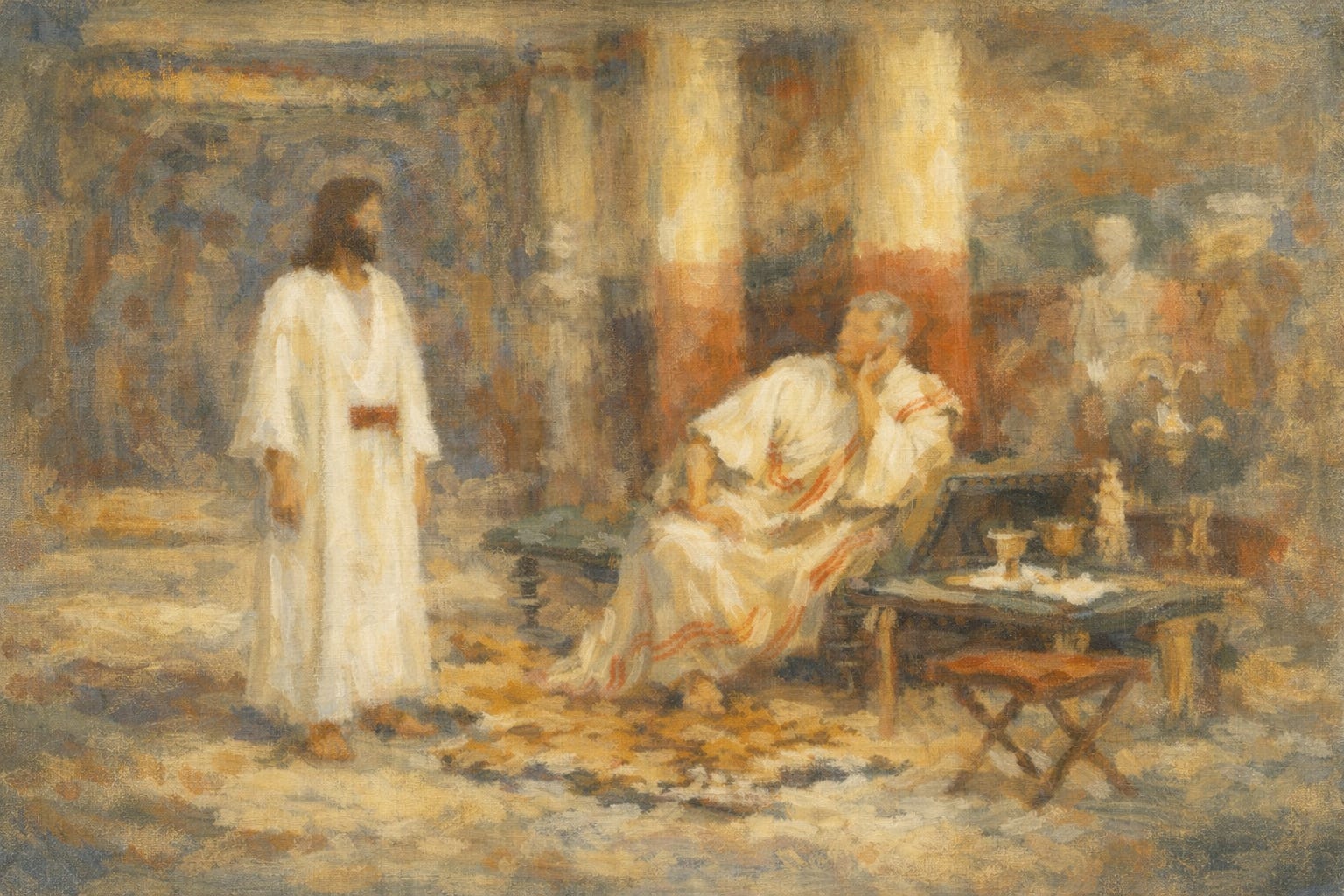
On the eve of Jesus’ death, the Gospels record a remarkable exchange between Him and Pontius Pilate, the Roman governor of Judea. While Jewish authorities sought to put Jesus to death for blasphemy, Roman law forbade them from carrying out executions, placing the final judgment in Pilate’s hands. Pilate’s concern, however, was not religious. It was political. He needed to know whether Jesus posed a direct threat to Rome.
When Pilate questioned Jesus, it became clear He was not seeking to overthrow the government. Jesus told Pilate that His purpose was to testify to the truth, and Pilate openly acknowledged that he found no guilt in Him.
Yet Pilate was trapped between truth and convenience. He knew Jesus was innocent, but he also understood his responsibility to Rome. He was tasked with keeping the occupied Jewish population under control, even as they aggressively demanded Jesus’ blood. Confronted with that tension, Pilate chose a familiar path.
He asked Jesus a simple question: “What is truth?”
Without waiting for an answer, Pilate turned and walked away. He publicly declared Jesus innocent, yet still handed Him over to be brutally executed by crucifixion.
Like so many today, Pilate asked a question not to discover truth, but to avoid knowing it and the accountability that follows. Instead of choosing what was right and accepting the personal cost, he stepped away from truth altogether and the responsibility that knowing it demands.
Evading the Obvious
Truth, properly defined, is not mysterious or elusive. Truth is simply that which matches reality.
Truth is not complex, profound, or hidden behind layers of abstraction. And yet, like Pilate, many in our modern age engage in forms of false intellectualism. Forms that sound sophisticated on the surface, but function primarily as a way to avoid accountability to what matches reality.
One common example is the belief that “truth cannot really be known.”
This mindset, known as radical skepticism, typically does not lead people toward truth, but away from it. No matter how much evidence is presented, there is always another question to ask, another doubt to raise, another way to evade what is plainly before them.
Anyone who has spent time with a young child has experienced this. The child asks what is initially believed to be a sincere question. You provide an answer, only to be met with “Why?” You answer again and are met with another, “Why?”
You explain again. “Why?”
At some point it becomes obvious that the child is no longer seeking understanding. The repeated “Why?” questions are not leading anywhere; they are simply delaying accountability (or trying to annoy you).
Captives of Bad Philosophy
Such mindsets do not arise from careful reasoning. Rather, they are rooted in bad philosophy that does not clarify truth, but instead obscures it. Scripture actually warns against this:
Paul is not condemning the pursuit of wisdom or rational thought. Both Jesus and Paul were masters of reason. A healthy degree of skepticism, for example, is necessary otherwise we would fall victim to every scam on the internet. What Paul warns against are extreme mindsets that sound insightful but quietly sever truth from reality and accountability.
And this warning matters, for if Jesus really is the way, the truth, and the life, then rejecting the very meaning of truth is not merely philosophical—it carries eternal implications.
One cannot place their trust in Jesus unless they first know He is true. And one cannot know He is true unless they believe that truth itself can be known.
When Ideas Defeat Themselves
The good news is that you don’t need a philosophy degree to spot bad worldviews. Most of them collapse on their own once you learn to recognize self-defeating beliefs.
Self-defeating beliefs are ideas that fail by their own rules. They can be tested by asking simple questions that reflect the claim back on itself. If answering the question creates a contradiction, the belief defeats itself and should be rejected.
Examine how easily the dominant bad philosophies of our culture unravel when they are tested against their own standard.

Skepticism
Skepticism is the view that no one can really know what is true.
Claim: “There is no truth.”
Response: “Is that true?”
Result: If the claim “there is no truth” is true, then at least one truth exists. The claim collapses and should thus be rejected.
Claim: “We can’t know what’s true.”
Response: “Can we know that claim is true?”
Result: If we can know that claim is true, then at least one truth is known. The claim again collapses.

Relativism
Relativism is the view that truth is just a matter of each person’s opinion.
Claim: “Everyone has their own truth.”
Response: “Is that true for everyone?”
Result: If yes, then there is at least one shared truth, which defeats the claim. If no, then the claim doesn’t apply to me.
Claim: “You shouldn’t judge others.”
Response: “Is that a judgment?”
Result: Saying someone “shouldn’t judge” is itself a truth judgment.
Note: Everyone makes judgments daily, though not all people judge honorably.

Materialism
Materialism is the belief that only physical matter exists. Materialists deny that non-physical aspects of reality exist, such as a soul.
Claim: “Only what you can touch or measure is real.”
Response: “Can you touch or measure that belief?”
Result: The claim cannot be touched or measured, and thus contradicts itself.

Scientism
Scientism is the belief that science is the only way to determine what is or isn’t true. If we can’t scientifically test it, it’s not valuable.
Claim: “Only science can tell us what’s true.”
Response: “Can science prove that claim?”
Result: No scientific test can show that science is the only way to know truth. Such a claim is philosophical, not scientific, thereby failing its own standard.
Claim: “Only claims that can be scientifically tested and falsified are meaningful.”
Response: “Can that claim be scientifically tested and falsified?”
Result: The claim cannot be scientifically tested or falsified, so by its own standard, it has no merit.
Note: Science is an excellent tool for discovering truths about the natural world, but as demonstrated, it is not the only test for truth.
The Truth is Knowable
Like Pilate, many today cloak their avoidance of truth behind what appears to be honest inquiry. Whether to satisfy a sense of intellectual sophistication or to unwittingly avoid accountability to what is plainly clear, the result is the same. Truth is often questioned in various forms, not to be discovered, but to be evaded.
Yet once we acknowledge that truth exists and that it can be plainly known, our posture changes. Questions are no longer used as shields, but as tools to better understand reality. Rather than hiding behind doubt, we are free to seek, examine, and ultimately respond to what is true.
The real question, then, is not whether truth can be known, but whether we are willing to live in light of it.
I like how you frame many of these skepticism as bad philosophy than true, honest reasoning.
In fact, Sir Francis Bacon (known as the father of empiricism) once observed, "A little philosophy inclineth man's mind to atheism, but depth in philosophy bringeth men's minds about to religion."
I love this kind of simple yet bone deep thinking. The unfortunate reality that many people asking questions are not in pursuit of Truth...but actually seeking to evade it. R
eally good post! Thanks for this!!