


Oftentimes when I write, I choose from a laundry list of questions pertaining to God that I have asked myself over the years. But on occasion, real-world interactions cause me to shift gears and address more immediate matters. This has been one of those weeks, as multiple people have coincidentally asked me about heaven.
Most seem to recognize heaven as a place of eternal paradise, even if we don’t fully understand it. But when people think through what it will be like, some rightly ask:
If heaven is a place where there is no evil, do we lose our free will there?
This question is fair. God created us as beings who are meant to love Him and one another.1 Everyone agrees that love is a good thing, but love must be given freely by definition; it cannot be forced. And because of this, God has given us the freedom to choose.
If God is love by His very nature, and He has given us the ability to love, then evil can be understood as a rejection of that love.2 When we lie, cheat, steal, or harm others, we are not acting in love, but choosing ourselves over God and others.
So here is where the conundrum lies.
Scripture says there is no more evil in heaven.3 But if love requires free choice, then it would appear we are left with two problematic options:
Our free will is removed, eliminating our ability to sin. But this also removes our ability to choose and to freely love.
Our free will is maintained, but that leaves no assurance we will remain in heaven forever. If we could choose sin again, we could fall again.
Neither sounds like a great option, but fortunately, this is a false dilemma when we think through how our free choice relates to God’s redemptive plan.

A False Dilemma
The primary issue with the presented dilemma is that it confuses freely made permanent choices with coerced ones. Moreover, it mistakes what heaven and hell actually are.
To help understand this, imagine a government that comes along and forcefully relocates everyone of a certain status or race under the threat of violence. A person with free will could certainly choose to disobey the relocation orders, but in doing so, they would face brutal persecution. Clearly, in this example, the choice to relocate is coerced.
In contrast, imagine a parent saying to their child away at college, “Don’t drink and drive, because bad things will happen if you do.”
In this example, the parent is warning about the consequences, not threatening to inflict them. If that child chooses to drink and drive and then gets in a wreck that kills someone, they have made an uncoerced choice. But that freely made choice, despite their parents’ warning, comes with permanent consequences.
Heaven and hell should not be compared with the example of a coercive government. God is not saying, “Choose me or I will torture you in Hell.” Rather, He gives us a choice like a wise parent who knows the consequences of rejecting what is right and choosing what is wrong.
Heaven is the result of our free choice to spend eternity with God on His terms. Hell is the result of our free choice to spend eternity on our terms, leading to separation from God, the source of goodness itself. That certainly leads to bad things.
But there is no middle choice, just as there is no room for divided commitment in a faithful marriage.
A woman who asks a man to commit to her fully in order to marry is not taking away his freedom. She is asking him to freely choose a life with her. And in choosing that life, he agrees to close the door on other relationships. That commitment does not make his love less free. It allows him to more freely love his wife.
As an aside, it seems odd that we expect lifelong faithfulness from one another in marriage, yet complain when God expects the same kind of commitment from those who wish to spend eternity with Him in heaven.
But this brings us back to the original question: a spouse can still break that commitment. What makes our eternity with God different?

Permanent Choice is Still Free Choice
If someone freely jumps off a cliff, can they reverse their decision once they are falling?
Or perhaps better stated, if someone has gangrene in their hand and freely decides to have it permanently amputated to save their life, has their free will been violated simply because they no longer have a diseased hand to use?
Of course not.
Jesus uses a similar image when He says, “And if your right hand causes you to stumble, cut it off and throw it away. It is better for you to lose one part of your body than for your whole body to go into hell.”4
Now, Jesus isn’t telling us to literally cut off our hands. He is demonstrating the seriousness of sin and the need to turn away from it. But the image also helps illustrate the point:
Freely choosing to give something up permanently does not mean we have lost our freedom.
A person who chooses to have a gangrene-ridden hand amputated, actually gains freedom because they are no longer weighed down by the pain of their decaying extremity. Likewise, a person who freely chooses to let God remove their sin has more freedom to love and enjoy life.
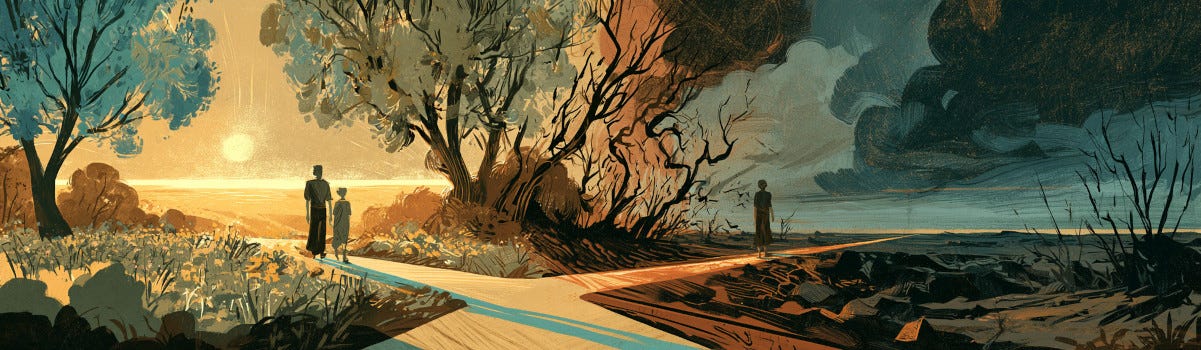
This is how we must think about heaven. During our time in this fallen world, we freely choose.
Do I want a life permanently free from sin, or a life where I get to forever define what’s right and wrong for myself?
Those who wish to be free from sin have no hope to achieve that freedom on their own. But thankfully, God gives us a path through Christ. And it is through Christ that our sin nature can be removed from us in a process known as glorification.5
Heaven is Not for Everyone
At this point people often ask, “Why couldn’t God have just made us free from sin at the start?”
But there is a difference between never having a choice and freely making a choice that lasts forever. Freedom does not require a permanent ability to sin. It requires that our love for God be genuinely chosen before that choice is perfected within us, making sin no longer possible.
In choosing eternity with God on His terms, we don’t lose our freedom. Rather, we allow Him to maximize it.
As Norman Geisler puts it:
“The perfection of our freedom is the freedom from sinning, not the freedom of sinning.”6
Now, of course, this won’t sound good to everyone. Not everyone wants God, the creator of everything, on His terms. But this is precisely why God gives us a free choice to begin with.
God isn’t going to force anyone to spend eternity with Him who doesn’t want to. He’s only going to bring people into heaven who want to be there. People who want to be faithful to Him, permanently free from sin, and ultimately free to love and thrive as a heavenly community with God at the helm.
Those in heaven get to spend eternity with the source of goodness Himself, where there is no more pain or suffering, sickness or death.
That sounds pretty awesome to me, but I recognize not everyone will agree. Some would rather retain the ability to define right and wrong for themselves. Either way, there comes a day when God no longer allows evil to interact with His good creation.
And so, God will restore those who wish to be restored, and give over those who wish to remain apart and operate on their own terms. But eternal separation from God ultimately becomes a prison of one’s own making. If you’ve studied history at all, then you know what atrocities humans are capable of.
Imagine how much worse it becomes when we are fully separated from the very source of all goodness. No thank you!
What free choice will you make?
See Gen. 1:26–27, 1 Jn. 4:8, and 1 Jn. 4:19.
See Jn. 14:15, and 1 Jn. 4:19.
See Rev. 21:1-4
See Rom. 8:18–23, 1 Cor. 15:51–53, Phil. 3:20–21, and 1 Jn. 3:2–3. For a helpful overview of the biblical doctrine of glorification, see “What Is Glorification?” at GotQuestions.org.
Norman L. Geisler, Systematic Theology, Vol. 4: Church, Last Things, 307.
“But there is a difference between never having a choice and freely making a choice that lasts forever. Freedom does not require a permanent ability to sin. It requires that our love for God be genuinely chosen before that choice is perfected within us, making sin no longer possible.”
I really appreciate this post, Justin. This is a great way to explain this answer. And you are totally right. It is a false dilemma based on faulty ideas of freedom. Solid apologetic here!
Another great article Justin!
I'll admit that when I read the title, I imagined you going in a different direction; but this was very well written and thought-provoking.
When I picture Heaven, the "glorious" side of it I suppose we garner from descriptions and glimpses throughout scripture.
However, the practical side of it, perhaps it's safe to assume we can gain from Genesis 1-2. There's abundance, instruction, relationship, and order. Take those things and then remove any temptation, enemy, or sickness, I wonder if a need of "free will" will even exist.
Clearly, you have my mind going in several directions, I love it!