


In the beginning, God created the heavens and the earth. - Genesis 1:1
Since the era of Albert Einstein, science has increasingly affirmed that the universe had a beginning. This conclusion is exactly what we should expect if God created the universe, because all created things have a beginning.
Yet while Scripture is clear on this, many great minds once assumed that the universe was eternal. This felt safe to some, because if the universe had always existed, there is no need for a God to create it.
But that assumption was unable to survive scientific progress. Once the evidence began to show that the universe began with a Big Bang, a problem emerged.
If the universe began to exist, then the universe requires a cause, as the Law of Causality shows.1
All things that begin to exist require a cause.
The universe began to exist.
Therefore the universe has a cause.
This argument, known as the Cosmological Argument, creates an unavoidable problem for those who reject a creator. If the universe has a cause, then the universe itself cannot explain our existence. As a result, alternative explanations, such as multiverse theory, have been proposed to avoid the God hypothesis.
In short, if a multiverse exists that can create universes, then it can serve as our creator and not a God we are accountable to.

A Theoretical Hail Mary
Multiverse theory is admittedly fun, largely because of how often it shows up in pop culture. The Spider-Verse is a great example. It allows Tobey Maguire, the superior Spider-Man, to cross paths with Tom Holland in a different universe. Because the concept has become mainstream, it is now easy to invoke as a replacement for God. But in the end, it is little more than a desperate Hail Mary pass.
One primary issue is that the existence of a multiverse is likely impossible to prove. Science, for example, only allows us to study the natural world. Anything outside our universe is, by definition, supernatural2 and therefore cannot be observed unless it somehow enters nature and reveals itself (as God has done).
But even if we assume for a moment that a multiverse exists, it cannot replace God. It simply kicks the can down the road, pushing the need for an ultimate explanation back one step further.
Which Multiverse?
There are many differing ideas of what a multiverse could be, but you do not need to know the nuances to see that none replace God. We can argue about the inner workings of these theories all day, but that is like debating the route of an airplane without first knowing its destination.
With that in mind, let’s take a look at some multiverse theories, which generally fall into a few broad categories. This overview is not exhaustive, but it captures what I find are the most common views.
I have tried to make this as lay-friendly as possible, but some of these concepts can get a bit deep. Stick with me. The payoff will be worth it. If you have a question along the way, leave a comment or shoot me a message and I'll do my best to clarify.
Infinite Possibilities
The infinite possibilities view, often associated with pop and meme culture, is the idea that there are an infinite number of worlds with an infinite number of possibilities in simultaneous existence. This is where jokes like “Somewhere out there is a version of me who made better choices” come from.
It may not be a serious theory, but many people I encounter actually have this idea in mind when discussing a multiverse, so it’s important to address it.
This solution attempts to eliminate God by claiming there is no need for an uncaused First Cause to set anything in motion. It is treated as a brute fact that infinite realities and possibilities simply exist simultaneously. This view, while fun to imagine, creates a couple of paradoxes which are also interestingly reflected in meme culture.
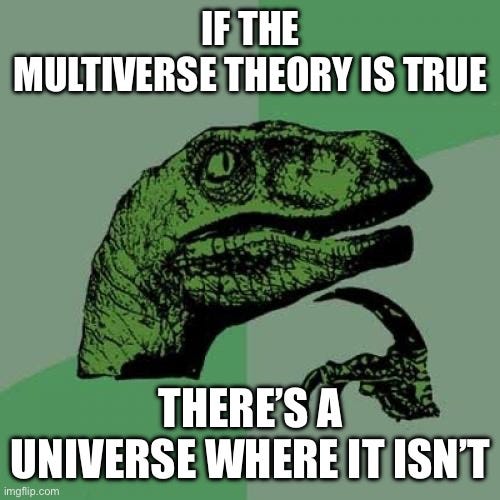
While the meme paradoxes like the one above are entertaining, a more serious challenge comes from Alvin Plantinga’s refined ontological argument. This argument for God, while often ignored in favor of stronger ones, is uniquely suited for demonstrating issues with a multiverse.3
In simple terms, the argument is as follows:
A possible world is a world that could exist.
A world containing a maximally great being (God) is a possible world.
If a maximally great being exists in a possible world, He would have to exist in every possible world in order to be maximally great.
We live in a possible world.
Therefore God exists.
Put plainly, if there were an infinite number of possible realities, then a reality in which God exists must be included as a possibility. But God, by definition, is omnipresent (everywhere at once). That means He is not confined to a single reality, but would exist across all possible realities.
So in a multiverse with infinite logical possibilities, proponents cannot simply dismiss God without special pleading. A maximally great being is logically conceivable, so rejecting one requires carving out an exception. But once that door is opened, there are no longer infinite possibilities, and the entire idea of infinite worlds with infinite possibilities begins to collapse.
The only way out of this paradox is to argue that God is logically impossible. Good luck making that case.
Eternal Past of Universes
This category includes some of the more plausible theories, which propose an infinite series of universes coming in and out of existence. Bubble theory could fit into this category.4
The specific details of these ideas are not particularly important. What matters is that they all assume an ongoing eternal process of dependent universes being generated.
If you read Can There Be More Than One God?, then you already know why this fails. That pesky issue known as infinite regress.

No chain of dependent events that has gone on forever can be traversed. If we have an endless chain of universes generating more universes, for example, then it would be impossible to arrive at our universe in the present.
I recognize this is mind-numbing, so to help illustrate, imagine that each universe generates another universe. If that chain of created universes had no beginning, then an infinite number of universes would need to be created before we could ever arrive at our universe.
This creates a problem, however. If an infinite number of universes precede our own, then each newly created universe still leaves an infinite number of universes between it and ours. No matter how many universes are generated, our universe remains an infinite number of steps away.

A multiverse of this kind appears implausible and does not remove the need for an eternal, uncaused First Cause (that which we call God). Everything still needs a starting point. Without a First Cause, there is no first universe. Without a first universe, nothing exists.
A Finite Past of Universes
To escape the problem of infinite regress, one could propose a multiverse in which only a finite number of universes exist. This is the type of view Stephen Hawking alluded to.5
This model still fails to remove God, and simply kicks needing Him down the road. If the multiverse itself were not eternal, then it too requires a cause and must ultimately have a beginning.
All things that begin to exist require a cause.
The multiverse began to exist.
Therefore the multiverse has a cause.
God as the necessary uncaused First Cause is not removed.
But let’s assume the multiverse containing a limited count of universes was itself eternal. After all, only things that begin to exist require a cause. In this case, the eternal multiverse could act in place of a personal God.
This may solve the causality problem, but it introduces another problem. How did it begin generating universes in the first place?
Only minds can suddenly decide to initiate change without external forces acting upon them. Waves do not simply happen, for example. Wind and gravitational forces create them. Likewise, a motionless mindless multiverse cannot suddenly decide to start creating universes.
Just as a row of dominos will never fall on its own, an eternal multiverse cannot suddenly produce universes unless something outside the system acts upon it. Eternity does not create motion. It only extends time.
So whether the multiverse is finite or eternal, the problem remains the same. Either it has a beginning and requires a cause, or it is eternally frozen, unable to ever initiate anything on its own.

Inference to the Best Explanation
Any attempt to explain the universe without God ultimately collapses into paradox, infinite regress, or a motionless state that still demands a mind to resolve it.
Theories proposed to escape the implications of an all-powerful being creating the universe may sound imaginative or even entertaining, but they are not provable. They are invoked not because the evidence demands them, but because God is simply not permitted as an option.
Even if God represents an inference to the best explanation given the evidence, He is ruled out in advance, and speculative theories without empirical support are then elevated and labeled “scientific” to fill the gap.
That is not sound reasoning. That is an escape from reality.
I am going to have to sift through this one a few times, I think, but I love the Spiderman meme!
Oh Justin! I don't have to tell you how "over my head" this is, but I very much appreciate the breakdown. I'm sure I've heard the term, multiverse, but certainly never understood what it meant until reading this article. Thank you.
The one part that stood out to me was in the "Hail Mary" section: "Anything outside our universe is, by definition, supernatural and therefore cannot be observed unless it somehow enters nature and reveals itself (as God has done)."
Now that makes total sense to me—although I never really understood the supernatural is this way before.
You had my mind swirling...but in a good way:)