


Why are we here? It’s a question that even the greatest minds have wrestled with. When something exists, we naturally assume there is a reason for it. When something begins, we conclude something caused it. This way of thinking isn’t just philosophical or religious. It’s how we make sense of the world.
If you read Does the Big Bang Replace God?, then you already know where this reasoning leads. If the universe itself had a beginning, what caused it?
This line of thinking is commonly referred to as the Cosmological Argument for God. In its simplest form, the argument looks like this.
All things that begin to exist require a cause.
The universe has a beginning.
Therefore, the universe has a cause.
But this conclusion alone only gets us so far. While it shows that the universe has a cause outside itself, how do we know a single personal God is that cause? What if some impersonal natural force is responsible?
This is where the Cosmological Argument truly begins to shine. Not only does it point to a personal God as the beginner of the universe, it also leads us to conclude that God must be one. And while Scripture certainly affirms this conclusion, we can arrive at it entirely through reason alone.
The Chain Must End
We know through scientific discovery that the universe had a beginning, often called the Big Bang. Interestingly, thinkers from antiquity, such as Saadia and Al-Ghazali, were able to reach this same conclusion long before modern science existed.1 They did so by identifying a logical problem known as infinite regress.
An infinite regress is simply the idea of an endless chain of past events. The problem is straightforward. You cannot cross an infinite distance. For example, if time had no beginning, then an infinite amount of time would have had to pass before reaching the present moment. But if that were the case, we would never arrive at now, because infinity has no starting point.
To help visualize this, consider the following demonstration. Imagine a vertical tube. The bottom of the tube represents the beginning of time. The top of the tube represents this exact moment. Each ball dropped into the tube represents a unit of time. It could be a minute, an hour, or an eon. The length does not matter.
As the balls are dropped, they fall to the bottom of the tube where time begins and stack on top of one another. Over time, the stack grows higher and higher until it reaches the top of the tube, which represents this exact moment.

Pretty simple right?
But here is the problem. If the tube had no bottom, and time had no beginning, then the balls would never reach the top. The stack would never form. The present moment would never arrive.

Yet here we are. That tells us something important. Time did not go on forever into the past. It had a starting point.
This challenge is not limited to time alone. It applies to all events, reactions, and motion. We can see this clearly in human birth. Every person comes from someone else. You have parents, who had parents, who had parents before them.
But no matter how far back you trace your family tree, it cannot go on forever. If there were no first humans, then no humans would exist today. Each generation depends on the one before it, and that dependence exists all at once.
The point is not just that things began long ago, but that what exists now depends on something else right now as well. In the same way, the universe cannot be explained by an eternal chain of dependent events, nor by an endless sequence of universes popping into existence.
Eternally Frozen
If an endless chain of events is impossible, then there must be a first cause that initiates everything, one that is by necessity eternal and uncaused. But how do we know this uncaused first cause is God, rather than some impersonal natural force?
The answer is simple. Nothing without a mind can set itself into motion.
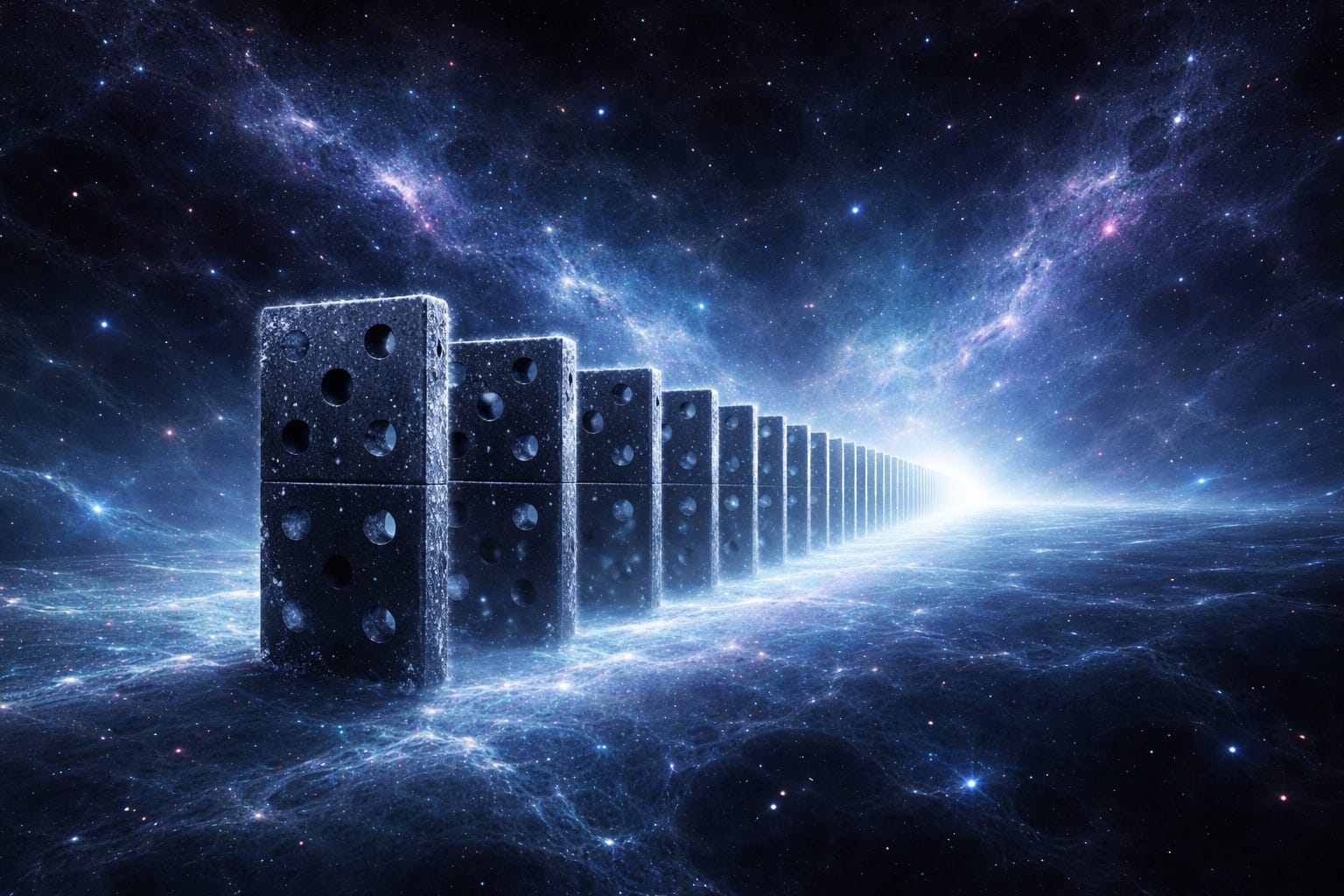
To help visualize this, imagine a long line of dominos, perfectly stacked and ready to fall. They have been sitting there for all eternity, completely still. No matter how long they sit, nothing happens. They remain frozen until something outside the chain acts on the first one. Unless one of the dominos has a mind and decides to topple itself over, it is clear they cannot start themselves.
So even if all the matter around us were eternal, motion itself must have had a starting point. Mindless forces cannot initiate motion on their own. They only act when conditions already exist.
If you are not convinced, feel free to look at this picture of eternal dominos and wait for them to move on their own. You may be waiting a while.
God Is Both Personal and One
The above examples show that there must be an uncaused first cause that both starts everything and does not depend on anything else. This is because an endless chain of events (infinite regress) is impossible. We have also seen that this cause must be personal (with mind), because mindless things do not act and start motion on their own.
Now, for some, it might be tempting to imagine multiple gods working together as the eternal first cause. But that idea quickly runs into trouble. If one god has something another lacks, then none of them is truly ultimate. And if none of them is ultimate, then the explanation still isn’t complete. At some point, reality requires a single source that lacks nothing and depends on nothing else.
Think about this in sports terms. If one athlete is better than another, it is not just a brute fact. There is an external standard of performance that both athletes are measured against. Perhaps its a low time, a high score, or even the most knockouts. The better athlete is always the one who more closely meets that external standard. But the standard itself is never the athlete. It stands above them, as the higher measure by which all athletes are judged.
The sum of this reasoning leads us to a single, ultimate source of all reality. One that does not lack love, power, justice, knowledge, or anything else. One that depends on nothing outside itself. One whose very nature is existence itself, and who stands as the final explanation for why anything exists at all.
What we find at the end of this reasoning is not an abstract force or an impersonal mechanism. We find a single, personal source behind everything that exists. One that lacks nothing and depends on nothing. This is exactly the God Christianity proclaims. Not some impersonal force or a god among others, but the one true God from whom all things come.
“For by him all things were created, things in heaven and on earth. All things have been created through him and for him. He is before all things, and in him all things hold together.” Colossians 1:16–17
William Lane Craig, The Kalam Cosmological Argument, Part 1, Wipf and Stock Publishers.
A lot to chew on here- but great writing and communication!
That was great. I appreciate when people can take high level thinking down to lay level.