


One thing holding many Christians back from sharing their faith is the fear of not being able to answer a challenge. No one likes the feeling of being caught off guard, and no one wants to walk away wondering whether they did more harm than good. That fear alone is often enough to keep us from entering important conversations.
While it is certainly wise to be as prepared as possible, the reality is that no person is all-knowing. If we allow the fear of being stumped guide us, we will never share truth at all.
Thankfully, the burden of answering every objection does not automatically rest on the believer’s shoulders. This is why understanding the burden of proof is one of the most powerful tools in conversation, especially with atheists.

Atheism Defined
Philosophical atheism has traditionally been understood as the positive belief that “God does not exist.”1 This distinction matters, because once someone asserts that there is no God, they have made a truth claim that requires support.
The burden therefore rests on the atheist to explain why that conclusion should be accepted.
In response, one is entirely justified in asking, “What reasons do you have for believing that there is no God?”
At this point one of two things will typically happen.
Authentic philosophical atheists will rightly recognize their burden of proof and attempt to defend their position. Sometimes the argument is that we do not see God (evidence of absence). Other times it is the claim that evil exists in the world (argument from morality). Those are sincere arguments and they deserve thoughtful engagement.
But much of the time, something different will happen. The person will pause and say, “Well, I can’t prove there is no God. I simply lack belief that one exists.”
And at that moment, the conversation has quietly shifted in a way most people are unaware of.
Retreating to Agnosticism
At first, saying “I lack belief” sounds like a fair response. But if atheism is reduced to “I am not convinced,” then the atheist has quietly removed any responsibility to defend their position.
In recent decades, many have redefined atheism along these lines. Even modern dictionaries have adopted this broader definition of “lacking belief.”2 Others, recognizing the tension, use labels such as agnostic atheist or weak atheist to describe the position.
Whatever terminology is used, the practical effect is the same: the burden quietly disappears, and the one who believes in God is somehow treated as the only person expected to present evidence for their view.
Do not be intimidated by it.
To see the issue clearly, we need to move away from debates about labels and definitions and instead consider the actual logical positions available. This removes the fog of wordplay that so often derails the discussion.
There are only three coherent positions:
• One can assert that God exists (theism). This is a truth claim and therefore requires supporting evidence.
• One can assert that God does not exist (atheism). This is also a truth claim and therefore requires supporting evidence.
• One can suspend judgment and assert that they are unsure (agnosticism). This makes no positive claim and therefore carries no burden of proof.
When someone truly suspends judgment, they carry no burden of proof because no truth claim is actually being made. They are simply saying that the available evidence does not settle the matter either way. In that sense, one is justified in lacking belief in God, but consistency also requires lacking belief that there is no God.
However, once someone claims that they “lack belief” in God while also maintaining the belief that “no God exists,” they are no longer merely suspending judgment. They are not just lacking belief in God, but also concluding that God does not exist.
One cannot consistently claim to be suspending judgment while simultaneously asserting a conclusion. The moment a positive claim is introduced, even implicitly, the burden of proof returns.
So, when someone claims to be an atheist because they merely lack belief in God, they have effectively combined two distinct positions. They have asserted that God does not exist (atheism) while also maintaining uncertainty about whether God exists (agnosticism).
Motte and Bailey
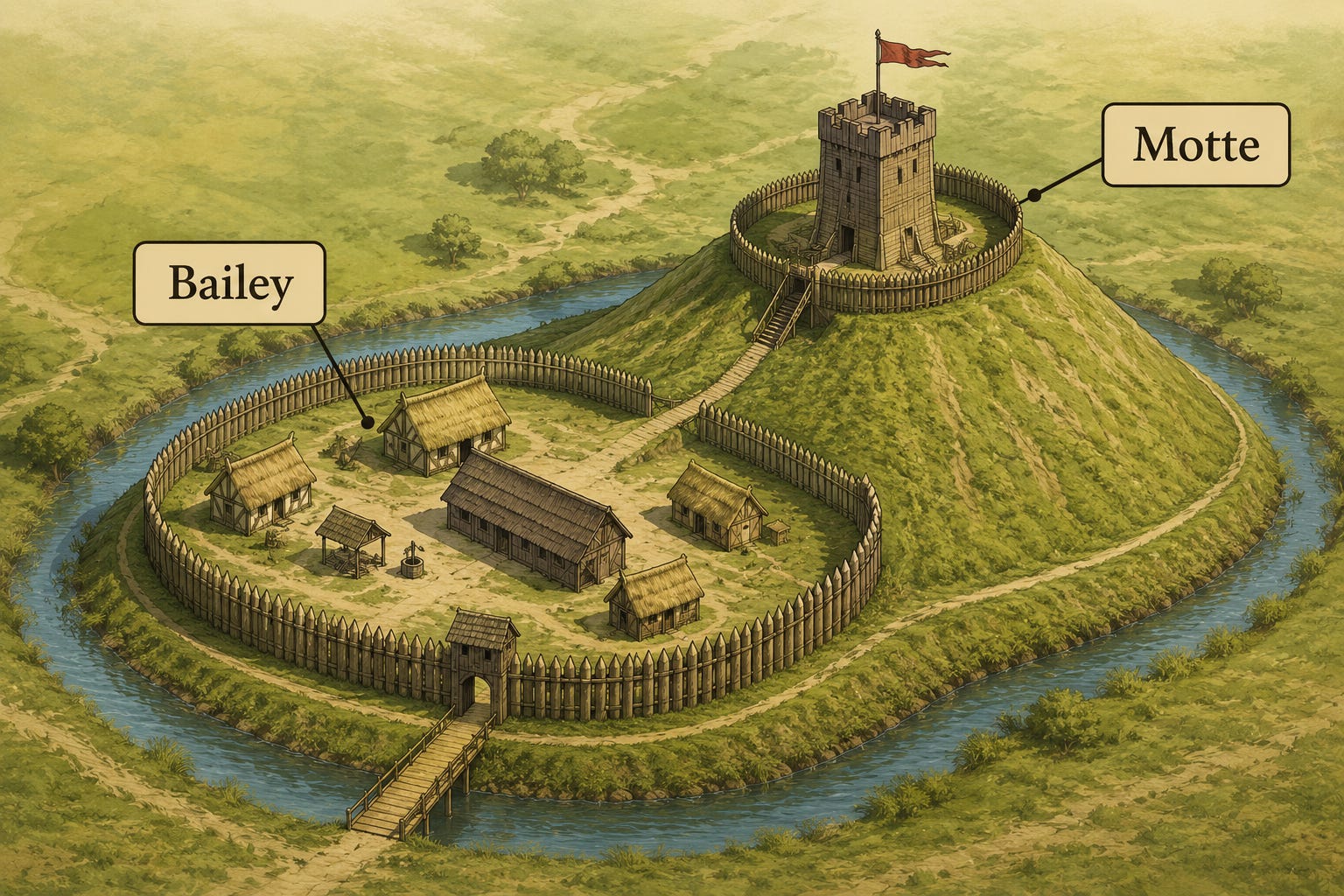
The image above shows what’s known as a Motte and Bailey. It was a medieval defensive strategy where people lived and worked in the wide, comfortable outer courtyard (the Bailey), but could retreat to the small, heavily fortified tower (the Motte) when under attack.
This same strategy often appears in debates about God and is widely recognized as a logical fallacy.3
A person may advance the atheistic claim that God does not exist (the Bailey). Yet when that claim is challenged, they retreat to the easier-to-defend agnostic position of merely lacking belief (the Motte). Once the pressure subsides, they quietly return to the Bailey and resume arguing that God does not exist, as though the larger atheistic claim had never been surrendered.
The Motte is easy to defend because in genuine agnosticism no defense is required. An agnostic truly suspends judgment. They lack belief in both directions. They do not affirm that God exists, nor do they affirm that God does not exist. They simply don’t know one way or another.
But the moment a judgment is introduced, such as concluding that God does not exist, belief is no longer suspended. A position is being held, and any valid conclusion requires justification, regardless of the strength of one’s conviction.
If one wishes to assert that God does not exist, that claim requires explanation.
If one wishes to suspend judgment, then no conclusion can be smuggled in under the language of neutrality. One cannot live comfortably in the Bailey and then retreat to the Motte when arrows begin to fly.
Avoiding Truth
No credible scientist would argue, “This theory is false, because I lack belief that it is true.” To conclude that a theory is false requires an explanation as to why.
The Christian, when challenged to defend belief in God, certainly would not get away with saying, “I simply lack belief that something came from nothing.” The atheist would (and should) rightly ask why God better explains reality. Likewise, if one concludes that God does not exist, it is completely reasonable to ask what justifies that conclusion.
Yet many atheists conclude, “There is no God,” without explanation. By retreating into a simple “lack of belief,” they argue from agnosticism while functionally living from atheism to make their worldview work.
But it is a logical contradiction to be both decided and undecided at the same time and in the same sense.
One might call this meaningless semantics, but it is not. It is about intellectual honesty. The distinction exposes whether someone is simply unsure (agnostic), rejects God because they believe the evidence supports His nonexistence (atheist), or weaponizes skepticism so that no burden to explain their belief ever rests on their own shoulders (Motte and Bailey).
As Christians, it is important to remember that we carry a burden of proof too. Scripture calls us to be prepared to give a reason for the hope we have in Christ. Yet we are not called to shoulder the burden for every opposing claim. Those who assert opposing truth claims carry a responsibility to explain and defend their position, just as we do.
But as Blaise Pascal once observed, “People almost invariably arrive at their beliefs not on the basis of proof, but on the basis of what they find attractive.”
If one cannot justify their belief, then perhaps their position is not rooted in evidence, but in desire.
The heart is often more powerful than the mind. Therefore, we do well to remember that our role is to simply be faithful and proclaim Christ. It remains the work of the Holy Spirit to convict people of truth.
Paul Draper, “Atheism and Agnosticism,” The Stanford Encyclopedia of Philosophy, accessed May 29, 2026, https://plato.stanford.edu/entries/atheism-agnosticism/#DefiAthe.
Encyclopaedia Britannica, s.v. “Atheism,” accessed May 29, 2026, https://www.britannica.com/topic/atheism.
Patricia Engler, “Logical Fallacies: Motte-and-Bailey Arguments,” Answers in Genesis, accessed May 29, 2026, https://answersingenesis.org/blogs/patricia-engler/2021/01/27/logical-fallacies-motte-bailey-arguments/.
This was really well thought out, now if only I could remember clearly all the facts when I am in the moment.🤣🤣 Truthfully so, it is the work of the Holy Spirit like you stated. I know I don't need to have all the answers, and I think that is what makes our faith come across more authentic.
I did want to say that the “Motte and Bailey” analogy was top tier. Great article and I think I got more out of the second read!